
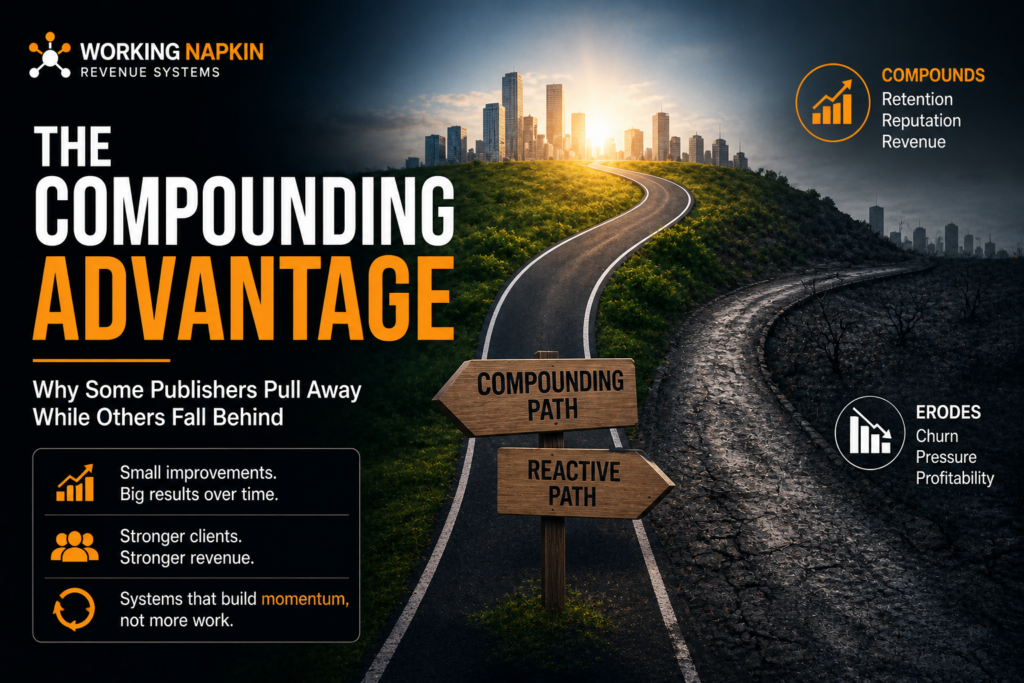
Most publishers are not separated by effort.
They are separated by what their effort builds over time.
Where the Gap Actually Forms
In most markets, the difference is not obvious at first.
Similar activity.
Similar offers.
Similar outreach.
Yet over time, a gap forms.
Some publishers stabilize and grow.
Others continue to work, without the same result.
This is not driven by one decision.
It is driven by compounding.
How Compounding Works in Revenue
Compounding in publishing is structural.
A small improvement in retention leads to more consistent revenue.
Consistency allows for reinvestment.
Better positioning attracts stronger advertisers.
Stronger advertisers produce better outcomes.
Each improvement reinforces the next.
Individually, these changes seem minor.
Together, they create momentum.
What Happens Without It
The absence of compounding creates a different pattern.
Higher churn increases pressure on sales.
Price sensitivity becomes more common.
Revenue becomes less predictable.
More effort is required just to maintain position.
Nothing collapses.
But progress slows.
The System Behind the Outcome
What appears as sudden success is rarely sudden.
It is the result of small advantages accumulating over time.
This only happens when there is a system allowing those advantages to build.
Without a system, improvements reset.
With a system, they carry forward.
What This Means for Publishers
Growth does not come from doing more.
It comes from ensuring each improvement is retained and extended.
At Working Napkin, this is the shift. Not toward more activity, but toward structuring revenue so it compounds instead of resetting.
Once that happens, growth becomes directional.
And direction, over time, determines who pulls ahead.