
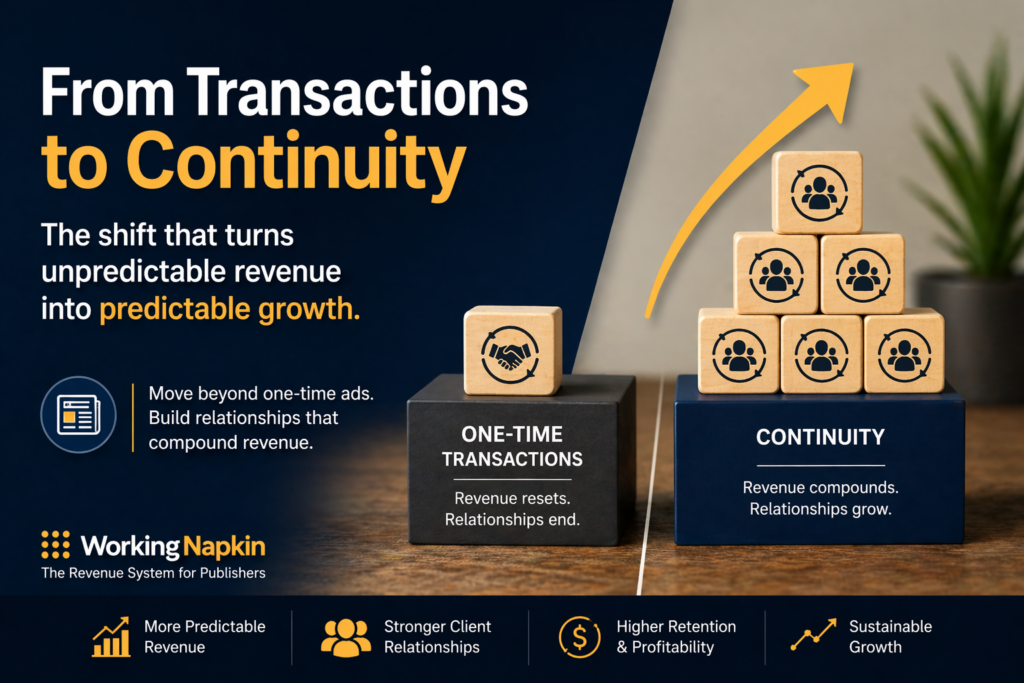
Most publisher revenue models are not broken.
They are just built for a different outcome.
Why Revenue Feels Inconsistent
Many publishers rely on one-time transactions.
An ad runs.
An invoice is paid.
The relationship resets.
At first, this appears efficient.
However, over time, it creates pressure.
Each month begins at zero.
Sales teams must continuously replace revenue.
Relationships remain shallow.
Revenue does not compound. It resets.
The Structural Limitation
The issue is not effort.
It is structure.
When revenue depends on one-time sales, growth requires constant replacement. What was sold last month must be sold again.
This creates volatility.
Revenue becomes difficult to predict.
Forecasting becomes less reliable.
Selling pressure increases.
The Shift Toward Continuity
Publishers gaining traction operate differently.
They design for continuity.
Instead of focusing on individual placements, they focus on the relationship.
What happens after the first campaign?
How does performance improve over time?
Where can the relationship expand?
This changes the role you play.
From selling ads
To solving ongoing business problems
Why This Changes Revenue Behavior
When continuity becomes part of the system, revenue behaves differently.
Relationships extend.
Client value increases.
Retention improves.
More importantly, revenue becomes visible and more predictable.
This is not a tactic.
It is a structural shift.
What This Means for Publishers
Growth does not come from selling more each month.
It comes from building a system where revenue continues beyond the first transaction.
Working Napkin exists inside this shift. It replaces isolated selling with a system that manages revenue across the full lifecycle, not just the initial sale