
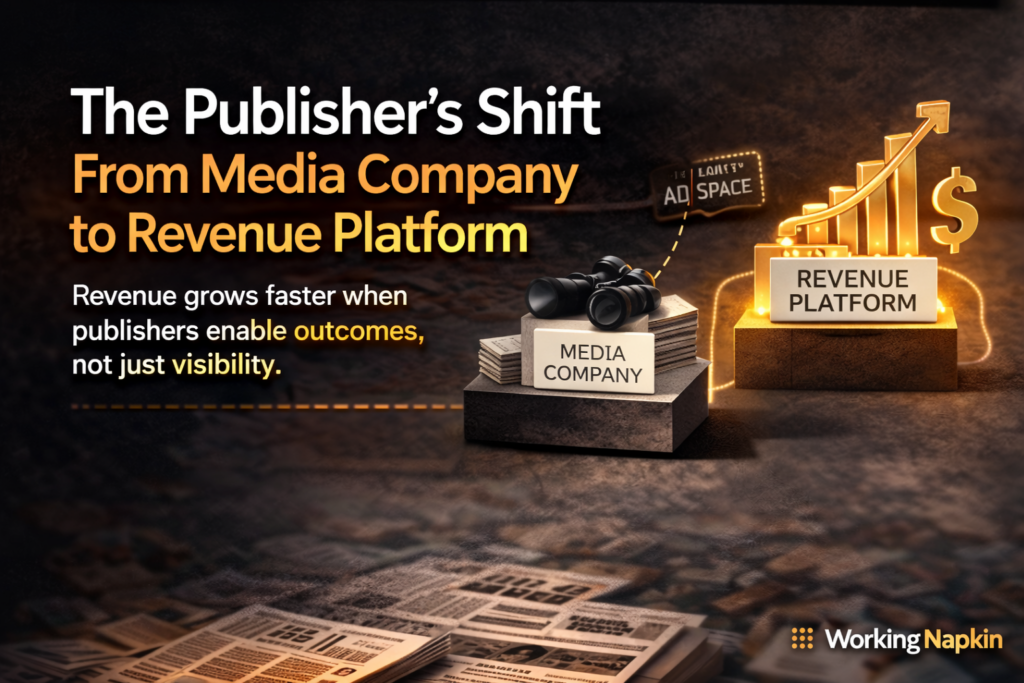
Most publishers still define themselves by what they produce.
The ones growing define themselves by what they enable.
Why the Old Model Feels Tighter
For years, the model was clear.
Create content.
Build audience.
Sell advertising.
That worked when attention was scarce.
However, the environment has changed.
Content is everywhere.
Distribution is constant.
Advertisers have more options than ever.
As a result, selling space becomes harder. Pricing pressure increases. Revenue becomes less predictable.
The Limitation of Thinking Like a Media Company
A media company focuses on inventory.
Impressions.
Placements.
Packages.
This creates a transaction-based model.
Each deal starts from zero. Each campaign is isolated. Revenue depends on continuous selling effort.
Over time, this limits growth.
The Shift Toward a Revenue Platform
Publishers gaining traction operate differently.
They use what they have already built.
Audience trust.
Local authority.
Business relationships.
Instead of selling space, they help businesses achieve outcomes.
This changes the conversation.
From exposure to results.
From transactions to relationships.
From campaigns to continuity.
Why This Changes Revenue Behavior
When the model shifts, revenue behaves differently.
Relationships last longer.
Client value increases.
Retention improves.
More importantly, revenue becomes easier to manage and predict.
This is not a tactic.
It is a structural change.
What This Means for Publishers
Your audience is not the product.
It is the asset that enables growth for others.
Your advertisers are not transactions.
They are businesses trying to improve outcomes.
Working Napkin exists inside this shift. It provides the system that allows revenue to move consistently without depending on constant selling effort.
If revenue feels inconsistent, it may be worth asking whether you are selling inventory or operating a system that produces outcomes.